

Jewelry case lighting has to show the facets of a ring, the outline of a necklace and the detail of the metalwork, without letting the fixture head draw the customer’s eye first. The narrower the case, the harder that balance becomes. Fixtures, mounting structure, glass and products are squeezed into limited space, and moving any one element slightly can expose a fixture, create a reflection in the glass or shift the light spot.
Mini spotlights offer flexible accent lighting, but “small” is only the starting point. Selection also has to consider where the fixture head sits in the customer’s sightline, how far the beam reaches, the finish color, and whether the light can be adjusted and maintained later. This article focuses on those decisions. The specific mounting structure should be determined from the chosen product and the case drawings.
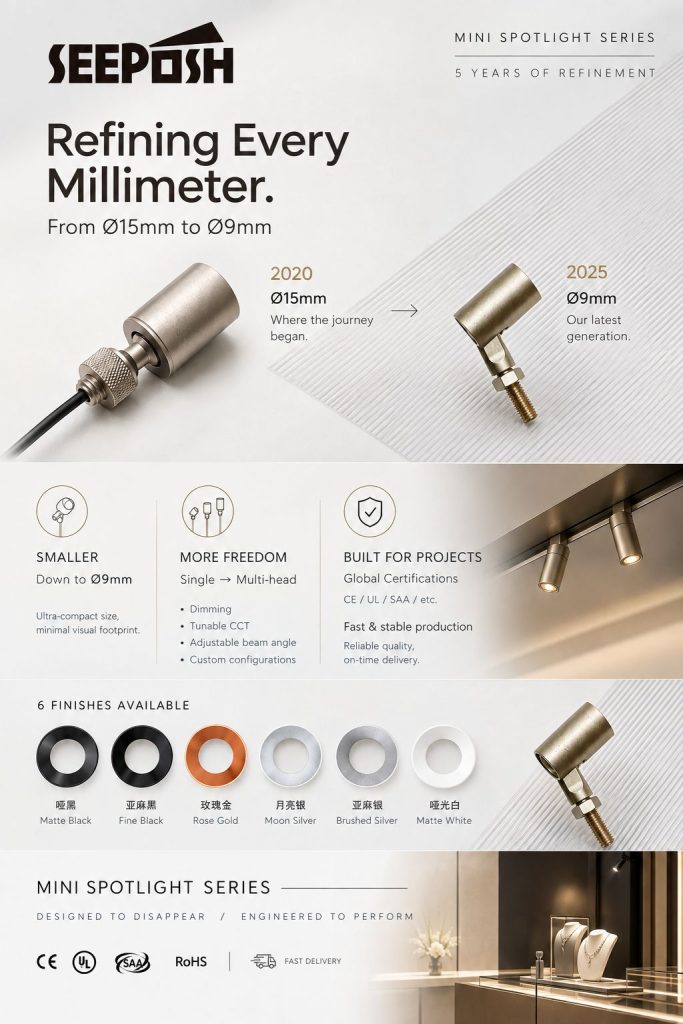
What space do you actually gain when the fixture head gets smaller?
SEEPOSH has spent five years developing and refining its mini spotlight series, from a Ø15 mm fixture head in 2020 to a new generation with a Ø9 mm head in 2025. The purpose of a smaller head is to give designers more room to hide fixtures in narrow frames, shallow cases and delicate displays, so that the jewelry reaches the customer’s eye before the fixture does. These two diameters show how the product has evolved. They do not mean the series comes in only two sizes, and the actual cutout and mounting requirements must be confirmed for the specific product you choose.
More importantly, a small head does not mean the whole system takes up no space. Mounting parts, cables, connection points and the driver still need room. When judging whether a case can use mini spotlights, look at the complete fixture and case assembly, not only the head diameter.
Draw what the customer will see first, then decide where the light goes
On the section drawing, mark the customer’s main standing positions, eye height and the product area. Then mark the solid parts of the case where fixtures can be hidden. Next, check three things: Does the fixture head fall directly into the sightline? Will the glass reflect the head? Can the beam land on the target product?
For example, a fixture hidden along the top edge of the case may still be visible from an oblique side angle. And a head that cannot be seen from the front may still leave a bright spot reflected in the front glass. For a case that can be viewed from both sides, check from each side. A “hidden position” on a drawing should be confirmed on a sample case with real glass and finishes installed.
Mini spotlights come with different mounting and combination methods. Which one to use should be decided by the case structure, the range of adjustment needed and the site’s installation conditions. One mounting method should not be described as the standard approach for every jewelry case.
Choose the beam to match the product and the display
Highlighting a single ring and keeping a full row of watches clearly visible are two different tasks. When choosing a beam, consider the distance from the fixture to the product, product size, how densely items are arranged and whether the display changes often. A beam that is too concentrated may light only part of a product. One that is too wide can weaken the focal point or throw excess light onto the glass and finishes.
If the products inside the case are changed on a schedule, also confirm whether the chosen configuration lets you re-aim the light and whether it is easy to lock again afterwards. SEEPOSH’s mini spotlight materials show configuration directions such as single-head and multi-head versions, dimming, tunable white and beam adjustment. The specific functions and available options depend on the final product solution. Do not assume every mini spotlight offers all of them.
Test with representative jewelry or material samples. Look at the front of the product, and also at the effect as a customer approaches, turns to the side and walks away. Only when the fixture, the product and the viewing position are confirmed together can you tell whether the accent light really serves the display.
Check glass reflections and fixture appearance together
In a narrow case, the fixture and the glass are often very close. Even when the head itself is small, a bright light aperture can still be reflected in the front glass or a mirrored finish. When adjusting the aim, look at whether the product gets brighter, and also at whether the light source enters the customer’s sightline and whether new bright spots appear on the glass.
Finish color also affects how well a fixture “disappears.” SEEPOSH’s materials show finish options including black, rose gold, silver and white. When choosing, place the fixture next to the real case materials to compare. A dark frame may suit a low-profile dark fixture body, while a metallic finish needs attention to reflection and color coordination. The finishes actually available should still be confirmed for the specific product and order.
Leave room for adjustment and service at the design stage
After the case is delivered, product positions may change, and fixtures or drivers may need maintenance. Before the case structure is finalized, the designer and the shopfitting team should confirm: Can the fixture still be re-aimed once installed? Will cables show behind the glass? Where is the driver? Will future service require removing a finished surface?
There is no single installation answer that applies to every project. SEEPOSH can discuss mounting, wiring and control solutions based on case drawings, the chosen configuration and project conditions. For a narrow display case, bringing lighting into the case design early is more reliable than looking for a place for the fixtures after construction.
From sample to project delivery: what else to confirm
Once a sample case is approved for one store, a project may go on to involve production of many cases, compliance documents for different markets and delivery schedules. SEEPOSH’s mini spotlight series is aimed at this kind of project need and can provide documentation for CE, UL and SAA certifications and RoHS compliance, along with fast, stable production and delivery. When you send an inquiry, include the target market, quantity and timeline, and the team can check the required documents and delivery arrangements against the specific product.
If you need different finishes, single-head or multi-head combinations, or configurations such as dimming and tunable white, settle them at the sample stage too. That way later production follows the appearance and lighting effect you have approved, not just an image of a fixture.
Four results to check on the sample case
Before confirming a solution, build a sample case using glass, finishes and products close to the final configuration, and check from the customer’s main standing positions:
- Does the product stand out? Does the accent land on the target jewelry, and does the whole display still have a clear hierarchy?
- Is the fixture discreet? From the front, the side and in the glass reflection, do the head, connectors or cables draw attention?
- Can it be adjusted? When the display changes, can the aim and brightness be reset within the agreed range?
- Can it be serviced? Has an access route for fixtures and drivers been left in the case structure?
If you are designing a shallow or narrow jewelry display case, you can send SEEPOSH the section drawing, case dimensions, glass and finishes, photos of representative products and the intended viewing directions. We can use them to discuss the mini spotlight configuration and sample case verification. You can also start with our product series overview and customization process, or send your project requirements through the contact page.
Frequently asked questions
Is a Ø9 mm fixture head suitable for every narrow display case?
You can’t judge from head diameter alone. Mounting parts, cables, aiming distance, case structure and customer sightlines all matter. Ø9 mm is one point in the product evolution shown in SEEPOSH’s materials, not a universal answer for every project.
Does a more hidden spotlight always mean better lighting?
Not necessarily. The fixture’s position must still let the beam reach the product and avoid obvious reflections. Check both the concealment and the product presentation on a real sample case.
Can I set cutouts and mounting methods directly from this article?
No. Mini spotlights come with several mounting methods, and cutout, fixing and wiring requirements must be confirmed against the specific product and the case drawings.


