

Cosmetics display shelving often has to fit fragrance, skincare and makeup of very different sizes into a limited shelf height. The lighting has to keep products and labels clearly visible while avoiding harsh glare off glass bottles and mirrored packaging. And if every shelf trails a length of exposed cable, adjusting shelf height or the product mix later becomes a hassle.
So this kind of shelving should not be designed around a single light strip or a single light panel. It is more useful to put the lighting method, the power path and how the shelves adjust on the same drawing, and ask: where does the display need a continuous, soft glowing surface? Where does it need light directed onto the front of the product? And once a shelf is moved, does the lighting still work?
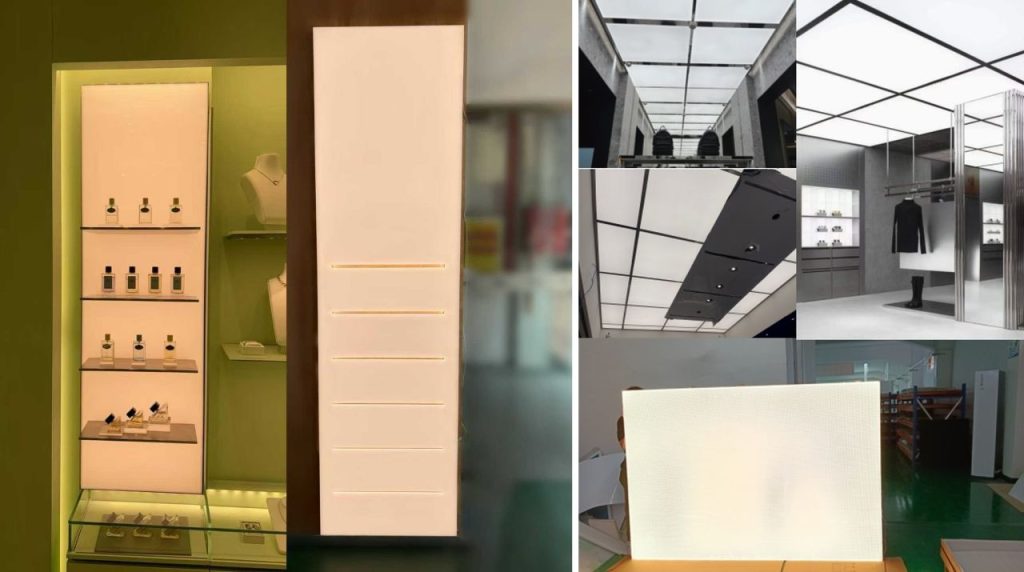
First decide: do you want the shelf itself to glow, or the product to be lit?
Illuminated shelf panels and linear lights solve different visual tasks. A light guide panel can turn the shelf itself into an evenly glowing surface, well suited to a light, continuous display look. A linear light hidden under or along the front edge of a shelf is better at directing light onto the products, labels or packaging on the shelf below. The two can be combined, but you don’t need both on every level.
For fragrance, for example, first decide whether you want customers to see a glowing shelf edge, a well-lit bottle, or both. For makeup shade displays, look further: does the light make it easy to compare similar colors? Does a highlight on the packaging cover up the color underneath? These questions should be judged in a real sample case with representative products, not decided from a rendering.
If a shelf needs to glow on both the top and bottom faces, consider the appearance from both sides, and whether products, brackets or wiring might block part of the glowing surface. The specific lighting method and dimensions should be confirmed against the shelving design.
If shelves are adjusted often, power delivery can’t be an afterthought
Cosmetics displays change with new launches, seasons and promotions. If exposed cabling has to be redone every time a shelf height changes, the lighting design ends up limiting the merchandising team’s freedom.
One approach is to build the power path into the shelving structure itself, so a matching shelf panel picks up power once it is slotted into the rail. This keeps the front of the unit tidier and makes it easier to reposition shelves to match the display. “Hidden power” here means the cables and connections are integrated into the structure as much as possible — it does not mean the whole system has no cables at all.
At the design stage, confirm whether the rail and the shelf panels use the same connection system, which adjustment positions are planned, and how contact, fixing and safe use are maintained after a shelf is repositioned. Rail length, power capacity, the connection method and how many shelves a rail can support should be checked against the final project plan, not estimated from a single product photo.
Check color accuracy at the product and at the try-on point together
Makeup displays are sensitive to color, but the shelf lighting is never the only light source a customer sees color under. Overhead ambient light, mirror lighting, the glowing shelf itself and reflections off the packaging all change how a color actually looks. A lipstick that looks right on the shelf can look noticeably different at the try-on mirror, which makes it harder for customers to compare shades.
So when settling on light color, put representative shades, skin-tone samples or real packaging into the sample case, and view them alongside the lighting at the try-on area. What you’re comparing is not whether one parameter is “higher is better,” but the product’s color, label readability and visual consistency between zones. If a project has specific color temperature or color rendering requirements, confirm them with the relevant product data and samples once the fixtures and the light guide panel’s light source have been selected.
Low heat can be a design goal, but check the actual working conditions
Fragrance, skincare and makeup may sit close to a lit shelf panel for extended periods. In certain configurations and use conditions, some of SEEPOSH’s illuminated shelf panel solutions keep the emitting surface below 32°C. This low-heat performance is a useful reference point for products displayed near a light source, but a specific project still needs to confirm the condition at the position the product actually touches or sits closest to, once the panel has been lit continuously.
When testing a sample, use the intended brightness setting, shelf structure, product arrangement and ambient conditions, and record clearly whether the measurement point is the emitting surface, the edge, the bracket or the product-contact surface. Temperatures measured at different positions, environments or with different methods should not be mixed together. The final figure for a project should be confirmed under its actual installation conditions.
Check four things together on a real sample
Whether a cosmetics display shelving system works cannot be judged from how good one lit shelf panel looks on its own. Check the following on a sample close to the final condition:
- Product presentation: Are bottles, shades and labels clear? Does any highlight obscure information customers need to see?
- The glowing surface: From the front and from the side, is brightness consistent between the shelf, its edges and neighboring levels?
- Adjustment in practice: After a shelf is moved, do the fixing and power connections still meet the design requirements? Does the front still look tidy?
- Operation and maintenance: Has the temperature under continuous use, the driver location and the future service route all been confirmed?
Photos are useful for recording how a sample looks, but they cannot replace these on-site checks. Color and brightness in particular can shift with the camera and exposure settings used.
What to prepare when discussing a project with SEEPOSH
If you are designing a cosmetics counter or adjustable illuminated shelving, start by providing the front view and section drawing of the unit, the number of shelves and their adjustment range, the types of products displayed, visible finishes, the power entry point, and the reference look you want to achieve. Also state whether you want the shelf itself to glow, or mainly want the products on the shelf lit — this affects the choice between light guide panels, linear lights and the power structure.
To see the range of fixtures that can be used with display shelving, browse SEEPOSH’s product series. If your project involves illuminated shelf panels, adjustable shelving or hidden power delivery, learn more about our customization process, and send drawings and your desired result through the contact page to discuss suitable samples and verification.
Frequently asked questions
Should cosmetics display shelving use a light guide panel or a linear light?
It depends on the effect you want. If you want the shelf to form a continuous glowing surface, evaluate a light guide panel first. If you want to light labels, packaging or the products on the shelf below, evaluate a linear light. The two can also be combined, and a sample case will show whether both are actually needed.
Is the power rail itself a light fixture?
No. The power rail provides a structured power path to a matching illuminated shelf panel or fixture. The actual lighting result comes from whichever lighting component is connected to it.
Does “low heat” mean any cosmetic product can sit directly on the glowing surface?
No. This should be assessed for the specific product structure, brightness setting, how long it stays lit, how products are arranged and the ambient conditions, measuring the temperature at the product-contact or nearest position when needed.


