

One retail shelf may need to do two things at once: make a full row of products easy to see and draw attention to a single featured piece. A gantry light brings illumination over the display from a horizontal bar supported at the sides. When we develop a Ling Series solution, we look beyond the shape of that frame. We also consider where the light leaves the fixture, where it lands on the merchandise, and whether customers will see reflections in the showcase glass.
We can customize focused lenses or diffused PC covers for every Ling Series gantry light model according to project needs. We can also develop a combination with other light sources. The display goal, fixture structure, and approved sample determine the final configuration.
Start with the display goal: one focal point or a full shelf?
When a shelf holds just a few watches, pieces of jewelry, or featured products, we first identify what should catch the customer’s eye. A focused lens can direct more light toward that position. The beam angle matters, but so do product size, mounting height, the edge of the illuminated area, and whether nearby products look too dark.
For a full row of merchandise, or when the horizontal bar should appear as a continuous, soft luminous surface, we can discuss a diffused PC cover. It shields the LED chips from direct view and gives the fixture a different appearance. We still check the products at both ends of the shelf: a diffuser alone does not guarantee identical brightness across the display. Fixture length, mounting height, merchandise layout, and the selected light source all affect the result.
Some displays need both approaches. We can use the linear section for general illumination and aim small adjustable spotlights at featured products, then confirm the combined effect with a sample.
| Display goal | Optical direction to explore | What to check in the sample |
| A few hero products need a clear visual focus | Focused lens, possibly combined with adjustable spotlights | Does the light reach the product? Do the beam edge, shadows, and reflections look natural? |
| Products are arranged across the shelf | Diffused PC cover or another wider distribution | Are products at both ends visible? Are LED points, bright patches, or dark areas noticeable? |
| The shelf needs base light and product accents | Linear light combined with directional light | Do the sources work together? Can the spotlights be aimed without shining into customers’ eyes? |
We use this as a starting point, then adjust the optics to the cabinet and merchandise. In a glass showcase, the customer’s viewing position and reflections can change how an otherwise suitable lighting arrangement looks.
Span and height change the effect of the same optics
Before we settle on a gantry light, we establish the distance between its two supports, the height above the products, the distance from merchandise to the front and rear glass, and any areas needed for doors or product access. Even with the same optical component, a taller bar or a denser product arrangement can change where the light falls.
Our Ling Series includes straight, curved, and combined structures. We can customize dimensions, appearance, and optics to the project. To develop a proposal, we ask for front and section drawings showing fixing points, cable exits, power supply location, and space for future access. Where practical, we make the sample close to the intended span and installation height, so a short sample is not used to judge the effect across a full cabinet.
If the showcase has glass, we also recommend checking reflections of the bar and light sources from a customer’s normal viewing position. A fixture that feels comfortable when viewed up close may look different through glass from an angle.
Our SP-25680-D combines linear light with two small spotlights
Our SP-25680-D places a horizontal light bar and two small spotlights on the same gantry structure. The bar can provide base light across the display, while the spotlights can be aimed toward products that need more attention. The photos below show an unlit sample and our internal lighting test. They illustrate the arrangement; the appearance of merchandise should still be checked in the project mockup.
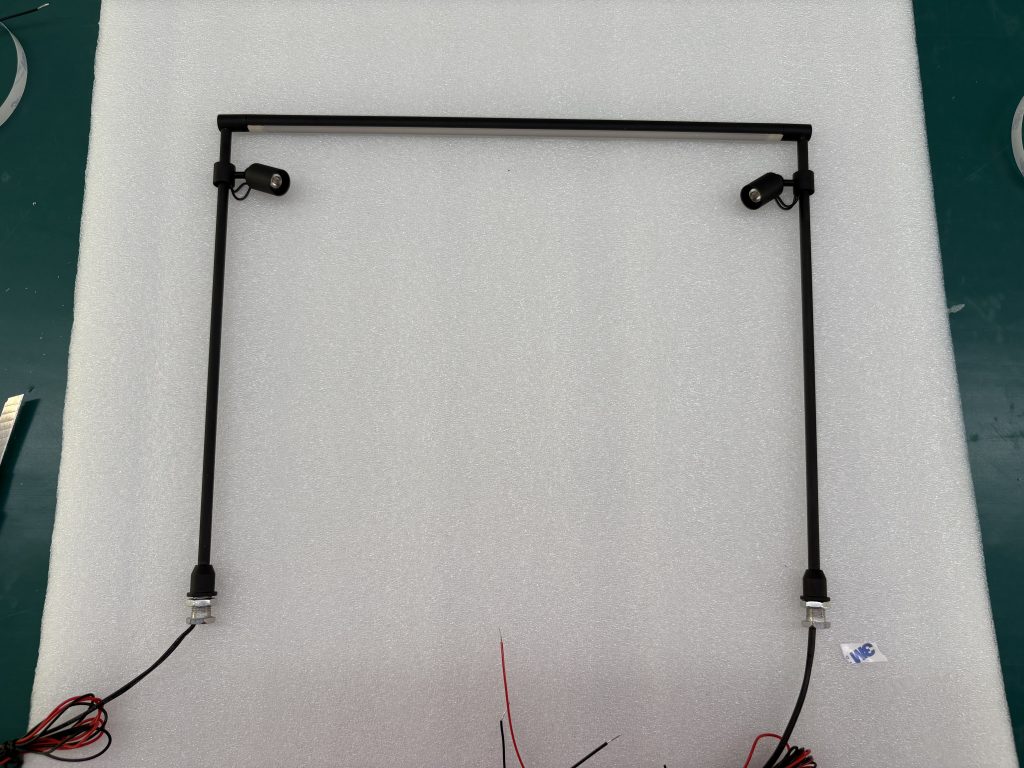
Our SP-25680-D sample, showing the crossbar, two spotlights, and the fixing and cable-exit positions at the base.
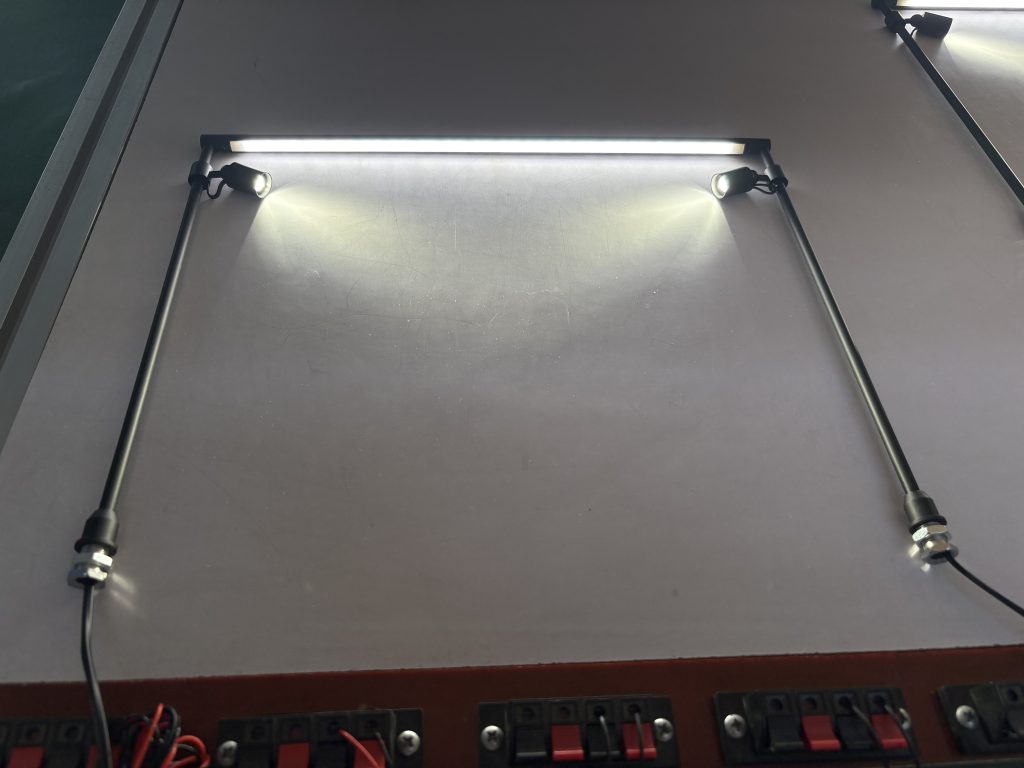
We lit the SP-25680-D crossbar and both spotlights on our test bench.
One SP-25680-D configuration we offer has a 350 mm crossbar, an overall height of 275 mm, and a fixture diameter of approximately 10 mm. It can be configured for DC 12 V or DC 24 V, with a color rendering index of Ra≥90, an IP20 rating, and a 12 mm mounting hole. We also offer beam-angle options for different project needs. If the dimensions, optics, or mounting method change, we confirm the corresponding electrical specification in the final drawings and sample.
How we confirm the final lighting effect
A test-bench photo lets us inspect the fixture’s construction and lit appearance. The final choice depends on how the merchandise looks inside the intended cabinet. We recommend four checks during sample approval:
- Add representative products. Include the tallest, darkest, and most reflective items. Put trays, price cards, and display props in place as well.
- Keep viewing conditions consistent. Use the intended fixture height, product positions, and glass where possible. Look from the front and from an angle. If comparing two options in photos, keep the camera exposure and ambient light as consistent as possible.
- Assess both light and fixture appearance. Is the featured product the first thing customers notice? Are edge products too dark? Can customers see exposed LEDs or a spotlight shining toward them? Do reflections in the glass compete with the merchandise?
- Record the approved configuration. Document the fixture dimensions, optics, beam angle, color temperature, finish, power supply, control, and cable exit. This gives production a clearer reference than an order for a “Ling Series gantry light” alone.
If both approaches look promising, we can arrange a project-specific sample comparison with the same cabinet and product positions. After approval, we record the selected effect and configuration for production and later review.
What to send us for a Ling Series proposal
Start with the showcase’s front and section dimensions, the types and density of merchandise, and the products you most want to emphasize. Show whether the fixture can be fixed and wired through the two lower supports. Tell us whether the cabinet has glass, where customers usually stand, and whether you want to compare focused accents, a soft continuous linear appearance, or a combination.
We can then discuss a suitable Ling Series structure and decide which focused lens, diffused PC cover, or other options need a sample. For details about the mounting, joints, and finishes of one related model, read our SP-17233 gantry light article. To begin a custom project, see how we customize lighting and contact us with your requirements.
FAQ
Is each Ling Series model limited to either a focused lens or a diffused cover?
No. We can customize focused lenses and diffused PC covers across the Ling Series according to the customer’s needs. We confirm the optical structure, any combination of sources, and the final appearance against the selected model and project drawings.
Do I still need spotlights if I choose a diffused PC cover?
That depends on the display goal. If the shelf needs soft base light but one product should stand out, we can explore a linear section combined with small spotlights. A mockup with the actual merchandise is the best way to decide whether both are needed.
Can you specify the fixture length from the cabinet width alone?
We also need the support positions, available height, product layout, glass frame, and cable-exit space. We confirm the relationship between the fixture and merchandise on front and section drawings; custom dimensions follow the approved drawings.


