

A backpack may stand much taller than the smaller bag beside it. Handles, straps and front pockets can block light from reaching parts of either product. A linear light at the top of the cabinet creates a continuous line of light, yet the lower front, pocket or side of a taller bag may still be in shadow. Effective bag display lighting depends on whether the light reaches the parts of the product customers need to see.
Our linear lights can be installed at the top of each display compartment to illuminate bags and accessories. We plan the fixture position and beam coverage around the actual sizes of the products, then check the result in a sample cabinet arranged close to the final display.
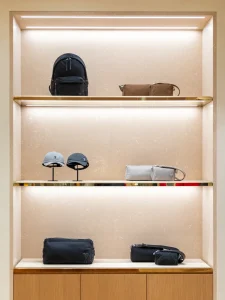
Start with the Front of the Bag
A linear light mounted at the top of a display compartment shines down onto the merchandise and can fit into the cabinet’s horizontal lines. Bags, however, are three-dimensional. A backpack has depth, a smaller bag may lie flat, and handles, straps and front pockets can cast shadows. The same light will reach bags of different heights in different ways.
We begin by marking the light position, compartment height, and the highest and frontmost points of the bags on the cabinet section drawing. We then check the front of each bag from the customer’s viewing position. If the light is too far back, it may brighten the rear panel while leaving the front of the bag dark. If it is too far forward, customers may see the light source directly, and polished finishes may reflect it into their view. The right position depends on cabinet depth, product arrangement and viewing angles.
When the Bag Is in Shadow, Compare Beam Coverage
When part of a bag does not receive enough light, we consider a linear light with a wider beam angle to cover more of the display area. Our SP-16242 is one option for this approach: it has a 120° beam angle, a color rendering index of Ra ≥ 90, a DC 12 V input and magnetic mounting. The driver location, mounting surface and cable route still need to be planned with the cabinet structure.
A wider beam changes the area the light covers, but a 120° specification alone cannot guarantee that every shadow will disappear. The distance from the light to the product, bag height, placement, and obstruction from handles or pockets all affect the result. If a tall backpack and a low bag share one shelf, check the upper and lower front surfaces and the sides of both products in the sample cabinet. Adjust the light position or spacing between products where needed.
There are two different decisions here. Choosing a wider beam angle changes the spread of light. Changing the fixture position or direction changes where the light enters the cabinet. Both may help, but neither is a fixed answer for every bag display.
Check the Bag, Metal Hardware and Cabinet Finishes Together
Buckles, zippers, metal tags and polished shelf edges can reflect a linear light. Some highlights help reveal details. If a bright reflection obscures a logo, buckle or surface texture, check the light position and product orientation from the customer’s viewpoint. A wider beam may cover more merchandise, so it is also worth checking whether it draws unwanted attention to the rear panel or metal trim.
For a useful sample display, place a tall dark bag, a smaller light-colored bag and a product with visible metal hardware in the cabinet. View them from the front and from an angle. Check whether their shape, color and details remain easy to see before deciding on the light’s position, the product layout or any additional accent lighting. This tells us more than looking at the light in an empty cabinet.
Test Three Parts of the Display with Real Products
Before finalizing linear lighting for a bag display cabinet, we recommend checking at least these three areas:
- The lower part of a tall bag: Do the handle, front pocket or bag body block light from the top? Can customers see the bag’s full shape?
- The front and side of a smaller bag: When a smaller product replaces a tall one, does the light still reach it, or mainly illuminate the rear panel and empty shelf?
- Hardware and trim: From the front and side, do reflections on buckles, zippers or metal shelves obscure details? Is the light source directly visible?
If products change frequently, we should not set the light position around a single arrangement made for a photo. We consider the usual range of bag heights and positions, then check that the selected mounting method, cable route and maintenance access work with the cabinet structure.
Discuss Your Bag Display Lighting with SEEPOSH
Send us a front elevation and section drawing of the cabinet, showing each compartment’s width, depth and height, the available mounting area at the top, and the approximate sizes and positions of the bags. If a sample display already has a dark bag front or distracting reflections, photos showing the affected product and viewing angle are helpful. We can compare linear lighting options, including the SP-16242, and identify what should be checked in a physical sample.
For more on arranging linear lights in retail spaces, read our guide to LED linear lighting for high-end retail. To discuss fixture placement, installation or samples for your cabinet, see how we customize lighting or contact SEEPOSH with your drawings.
Frequently Asked Questions
If part of a bag is in shadow, is a wider beam the only change needed?
A wider beam can cover more of the display and is one option to compare. The shadow may also come from the bag itself, the fixture position or the way products are arranged. Test with the actual bag styles before deciding whether to change the beam angle, the light position or both.
Is the SP-16242’s 120° beam suitable for every bag display cabinet?
Beam angle alone cannot determine suitability. Cabinet depth, compartment height, bag size and customer viewing angles all affect illumination and reflections. The SP-16242 is an option for wider beam coverage; the final effect should be checked against the cabinet drawings and in a sample display.
Can one linear light serve both backpacks and smaller bags?
Start by planning around the space both types of bag occupy, then check the lower front of a tall bag and the front of a smaller one in the sample cabinet. If one product type remains in shadow, adjust the light position, product arrangement or supporting lighting instead of judging the result only by how bright the light itself looks.


