


Introduction
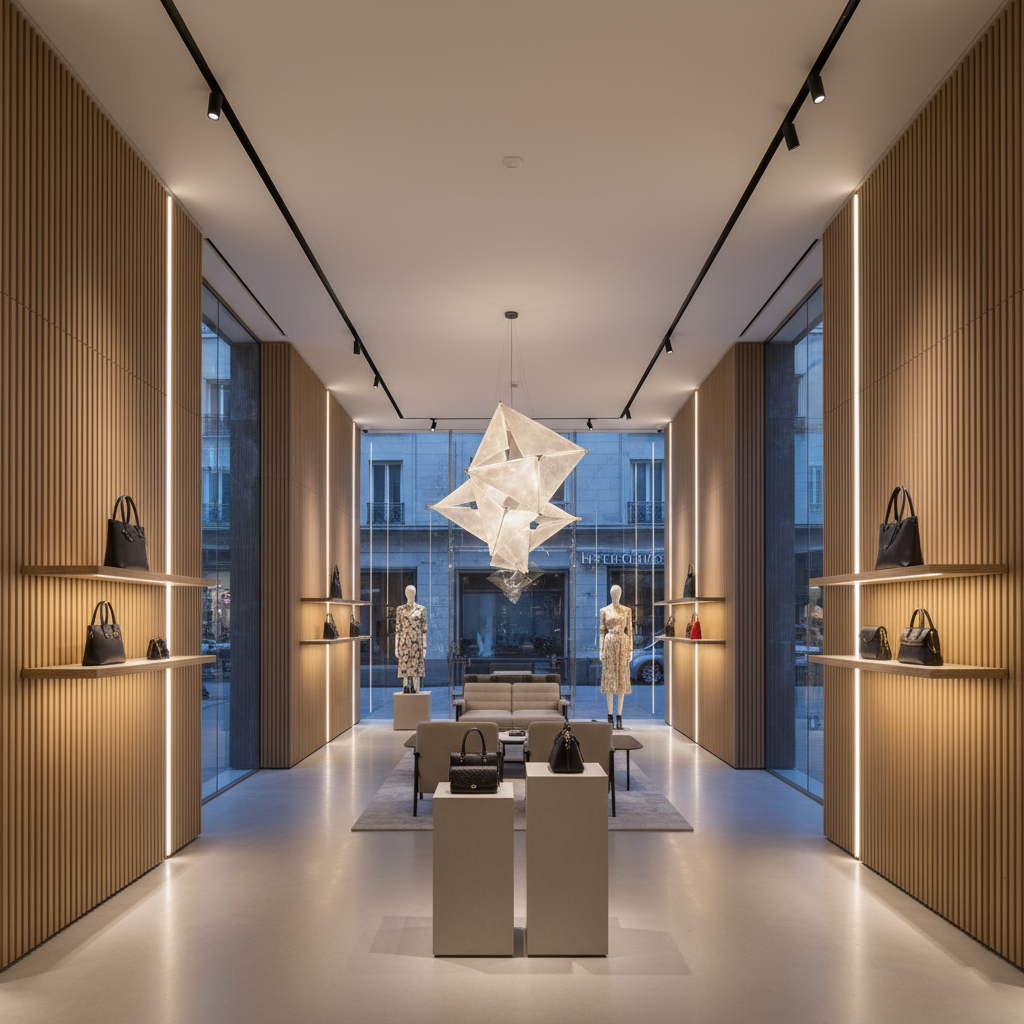
Why do some luxury flagships feel alive, vibrant, and emotionally resonant, while others feel static? The answer is often hidden in plain sight: the lighting. In today’s high-end retail environment, lighting is no longer a simple utility. It’s a core part of the brand narrative.
The old world of “on/off” switches simply cannot keep up. To create truly immersive environments that adapt to the time of day, a new product launch, or a VIP client’s arrival, brands need Smart Lighting Control. This article explores the most robust, trusted, and powerful standard in this space: the DALI Lighting System.
What is a DALI Lighting System?
DALI stands for Digital Addressable Lighting Interface. It is a standardized, two-way digital communication protocol that governs how lighting fixtures and control systems talk to each other.(Source: The DALI Alliance).
The most important word here is “Addressable.”
To understand why this is a revolution, consider traditional 0-10V analog dimming. It’s like a symphony conductor telling the entire violin section to play louder or softer at once.
A DALI Lighting System is different. It allows the conductor to give a unique, precise instruction to each individual musician.
On a single DALI circuit, every fixture (or “luminaire”) is given a unique digital address. This means you can control and group lights in software without ever changing the physical wiring. You can have a spotlight on a mannequin, a wall washer, and an ambient downlight all on the same circuit, yet control them as three separate groups.
How DALI Empowers the Luxury Retail Experience
For luxury retail spaces, this digital control unlocks three fundamental values that traditional lighting cannot offer.
Value 1: Creating “Dynamic Lighting Scenes”
A luxury space is not one-size-fits-all. A DALI system allows you to pre-program and instantly recall multiple “scenes” from a single control panel or even on a schedule.
- Day Mode: The storefront windows and entrance are bright (e.g., 4000K) to compete with daylight and draw customers in.
- Evening Mode: The entire space shifts. The lighting dims, the color temperature warms (e.g., 2700K), and spotlights become more focused, creating a sense of intimacy and exclusivity.
- Product Launch Mode: At the touch of a button, all ambient light fades to 30%, while the lighting on the new collection centerpiece punches up to 100%, creating a dramatic, high-contrast reveal.
Value 2: Operational Efficiency & Sustainability
Smart control is also smart business. Because DALI is a two-way protocol, the system doesn’t just “talk”; it also “listens.”
- Energy Savings: DALI integrates seamlessly with sensors. “Daylight harvesting” sensors near windows can automatically dim the artificial lights when natural light is strong, saving significant energy without any visible change to the atmosphere.
- Simplified Maintenance: Fixtures can report back on their status. When a driver fails, the system can tell a facility manager exactly which fixture in a 5,000-square-foot store needs service. This aligns perfectly with a brand’s ESG (Environmental, Social, and Governance) goals.
Value 3: Unmatched Visual Quality
The luxury experience is defined by quality, from the materials to the Science of Color Rendering (CRI & TM-30). DALI excels here. It enables smooth, “flicker-free” dimming all the way down to 0.1% intensity. Cheaper systems often flicker or simply “pop off” below 10%. This deep, smooth dimming is essential for creating subtle, high-end moods.
Furthermore, because DALI is a global standard, it ensures that fixtures from different manufacturers (if DALI-compliant) will respond identically to commands, guaranteeing perfect consistency across your space.
DALI vs. Casambi: Which Smart Lighting Control is Right for You?
This is the most common question we hear from architects and designers. Both are brilliant Smart Lighting Control technologies, but they serve different primary needs. We’ve broken down the key differences:
| Feature | DALI (Wired) | Casambi (Wireless) |
| Technology | Wired 2-way digital protocol | Wireless Bluetooth Mesh |
| Best For | New Builds, large-scale flagships, BMS integration | Retrofits & Renovations, pop-ups, galleries |
| Installation | Requires dedicated 2-core control wire | No new control wires needed; uses existing power |
| Reliability | Extremely robust. The industry “gold standard.” | Very reliable, but like all wireless, can be subject to interference. |
| Flexibility | Groups changed in software, but physical location is fixed. | Highly flexible. Re-group and re-program on-the-fly via an app. |
The Seeposh View: The choice is not about which is “better,” but which is “right” for your specific project. The decision depends on scale, budget, and whether it is a new build or a renovation. Both DALI and Casambi are powerful tools in design-and-supply arsenal.
Conclusion: Let Your Lighting Tell Your Brand Story
Adopting a DALI Lighting System or a similar Smart Lighting Control solution is a strategic shift. It moves your lighting from a static background element to a dynamic, narrative-driven tool. It gives you, the designer or brand manager, the power to “direct” the customer’s journey and craft an emotional experience.
At Seeposh, we don’t just supply fixtures; we provide complete lighting strategies. If your project is considering the move to intelligent lighting, contact our lighting solutions experts today.
Frequently Asked Questions (FAQ) about DALI Lighting
Q1: Is DALI still relevant in 2025 with so many wireless options?
A: Absolutely. In new construction, DALI is still the undisputed “gold standard” for reliability, stability, and large-scale integration. It is the preferred choice for major commercial and high-end retail projects where failure is not an option.
Q2: Can you add a DALI system to an existing building?
A: It can be challenging, as it requires running new low-voltage control wires to each fixture. This is why wireless solutions like Casambi are often a more popular and cost-effective choice for retrofit projects.
Q3: Does a DALI system save money?
A: Yes, in two ways. First, through intelligent control (scheduling, daylight harvesting, sensors) that significantly reduces energy consumption. Second, through reduced maintenance costs, as the system can self-diagnose and report fixture failures, saving countless hours of manual troubleshooting.
Q4: What is the difference between DALI and DALI-2?
A: DALI-2 is the latest version of the standard. The biggest improvement is that DALI-2 includes controls (like sensors and wall panels) in the standard, ensuring interoperability. DALI-1 was primarily focused on the fixtures. For any new project, you should always specify DALI-2 compatibility.


