


Introduction
Imagine this: You have just finalized a perfect minimalist lighting design for a high-end jewelry store client. The renderings look stunning. But when the contractor switches the lights on for the first time, you see it—inconsistent brightness, glaring dark spots, and visible aluminum joints. At that moment, LED linear lighting stops being a design element and becomes a project nightmare.
At Seeposh, we understand this frustration. We know that in luxury retail environments, light is not just about visibility—it is an extension of the brand’s value. Today, we will dive deep into how to select and install the right linear fixtures that satisfy the designer’s vision while solving the installer’s real-world challenges.
What Defines “High-End” LED Linear Lighting?
Not all LED linear lighting is created equal. There is a massive technical gap between generic strips found on e-commerce sites and professional-grade products designed for luxury retail. For high-end projects, “Quality” primarily means Truth.
This brings us to CRI (Color Rendering Index). Standard linear lights often have a CRI of around 80, which can make expensive watch materials look dull or wash out the vibrant colors of a fashion collection. High-end projects demand a CRI > 95, and crucially, a high R9 value (saturated red), to render textures authentically.
Expert Tip: If you are displaying gold or wood interiors, opt for a 3000K color temperature; for diamonds or silver accessories, 4000K LED linear lighting will make the products sparkle.
For more technical details on how color rendering affects retail perception, you can refer to the International Commission on Illumination (CIE) resources.
Solving the “Dot Effect”: Seamless Illumination
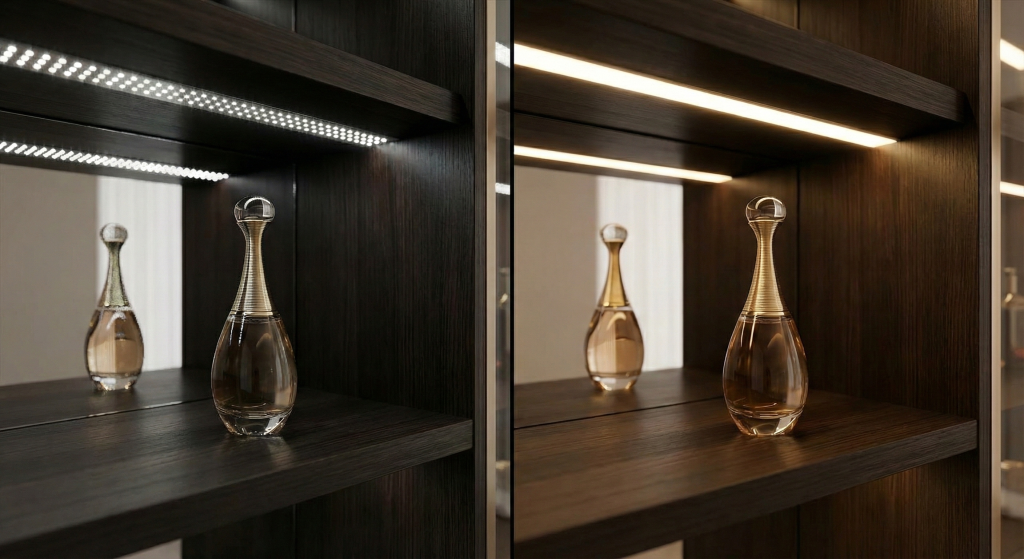
Designers’ biggest fear with LED linear lighting is the “dot effect” (pixelation). It looks cheap and distracts customers from the merchandise.
Many installers try to fix this by using thicker diffusion covers, but this significantly reduces brightness (lumen output). If you are still relying on traditional SMD strips paired with deep aluminum profiles, you might be sacrificing efficiency for uniformity.
The Bridge Solution: Adopt COB (Chip on Board) technology or high-density SMD (over 240 chips per meter).
COB Technology: Chips are packaged directly onto the substrate, creating a solid line of light without needing a heavy diffuser.
High-Density Options: Even in ultra-slim profiles, these ensure a smooth, water-like flow of light.
For the installer, this means no more time wasted adjusting diffusers to hide hot spots.
The Installer’s Nightmare: Cutting and Heat Dissipation
We know that for the on-site team, the durability and ease of use of LED linear lighting often matter more than the spec sheet. A common pain point is strips that cannot be reconnected after cutting, or aluminum profiles that warp because they are too flimsy.
At Seeposh, we treat installation convenience as a core product feature.
Heat Management: If your project is located in tropical climates such as Southeast Asia (e.g., Thailand or Singapore), high temperatures are the biggest challenge. Poor quality aluminum can lead to rapid light degradation. We use special aluminum materials suitable for tropical regions, ensuring that our LED linear lighting fixtures maintain their brightness for 50,000 hours, even under continuous commercial use.
Voltage Drop: Why Your Lights Dim at the End
Have you ever encountered a 10-meter run of LED linear lighting where the beginning is bright, but the end is visibly dimmer? This is called Voltage Drop.
For large commercial spaces, this is a huge challenge. To fix it, installers often have to run new power wires every 5 meters, which complicates the wiring and increases labor costs.
To understand the physics behind this, you can check this guide on Voltage Drop calculations or similar engineering resources.
Seeposh’s Solution: We offer Constant Current IC linear strips.
Traditional Strips: Brightness fades after 5 meters.
Seeposh Version: Supports single-ended power for up to 15-20 meters with consistent brightness from start to finish.
This allows installers to use fewer power drivers and reduce the number of access panels in the ceiling, keeping the design clean.
Integrating with High-End Retail Design
LED linear lighting is not just for ceilings. In modern luxury store design, it is versatile:
- Kick-plate Lighting: Creating a floating effect for counters.
- In-cabinet Lighting: 45-degree profiles focus light on the product, not the customer’s eyes.
- Wall Washing: Evenly illuminating stone or fabric feature walls.
We understand that commercial projects operate on tight schedules. Unlike some market options that might require months for production, Seeposh prioritizes efficient production scheduling. We work closely with your project timeline to ensure that your custom lighting solutions arrive exactly when you need them for installation, ensuring your store opens on time.
Conclusion
Selecting the right LED linear lighting is a balancing act—satisfying the designer’s obsession with perfect light while respecting the installer’s need for efficiency.
- Focus on Light Quality: Choose high CRI > 95 for true color representation.
- Eliminate Dots: Use COB or high-density technologies.
- Think About Installation: Choose products with good heat dissipation and long-run (constant current) capabilities.
At Seeposh, we don’t just sell lights; we provide lighting environments that ensure your design vision is executed flawlessly.
Ready to upgrade your next retail project? Contact our Lighting Experts for a free layout consultation.
FAQ
Q1: What is the difference between LED Linear Lighting and traditional tubes?
LED linear lighting provides seamless, continuous light that can be customized in length and shape. Compared to traditional fluorescent tubes, it is more energy-efficient, has a longer lifespan, and offers superior color rendering, making it ideal for high-end commercial spaces.
Q2: Can your linear lights be used in humid environments (e.g., semi-outdoor restaurants in Singapore)?
Absolutely. For humid or tropical regions, we offer LED linear lighting products with IP65 or IP67 ratings. We use a special silicone potting process that provides excellent moisture resistance and prevents yellowing from UV exposure.
Q3: How do I avoid glare when installing linear lights?
We recommend using aluminum profiles with deep-recessed designs or adding accessories like Honeycomb Louvers. Additionally, the Seeposh team can assist with installation node design to ensure the light is felt but the fixture is hidden (“Light without the fixture”).
Q4: What is the typical delivery time for Seeposh orders?
We understand that commercial renovation schedules are strict. While the exact time depends on the specific order volume and customization requirements, we optimize our production to ensure a fast turnaround that meets your commercial project deadlines. We strive to be the partner that never delays your opening day.


