


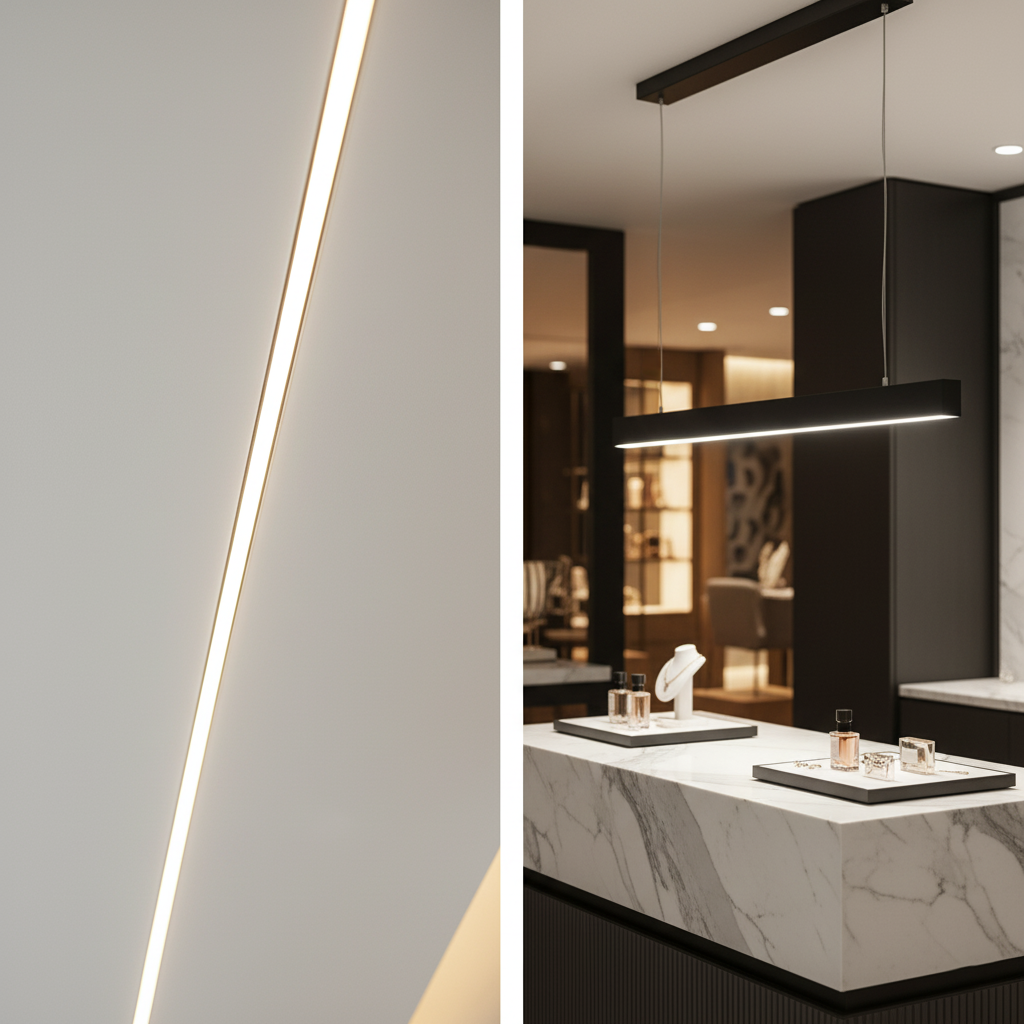
Introduction: Light, More Than Illumination, is the Language of the Luxury Retail Experience
In the world of high-end retail, light is a silent narrator. It sculpts spaces, guides emotions, and defines the perceived value of every product it touches. In a market saturated with visual noise, how does a luxury brand create a memorable physical experience that transcends the transactional? The answer lies in crafting a signature “brand light”—an atmosphere that is both unique and unforgettable.
This is where linear lighting systems move beyond simple function to become a powerful, versatile tool in modern retail lighting design. With their ability to seamlessly merge with architecture, they offer a sophisticated language for designers to tell a brand’s story in lines of pure, uninterrupted light. For a deeper dive into the psychology of how lighting impacts customer behavior, see this study on [Retail design: lighting as an atmospheric tool, creating experiences which influence consumers’ mood and behaviour in commercial spaces].
The Aesthetic Value: Why Linear Lighting is Favored by High-End Retail Designers
The appeal of linear lighting in luxury environments stems from its profound alignment with the principles of modern, minimalist design.
Minimalism and Elegance: Its clean, geometric forms create a sense of order and sophistication. It complements, rather than competes with, the retail space’s architecture and the products on display.
A Guide for the Eye: Lines of light act as a natural wayfinding tool, creating visual pathways that guide a customer’s journey through the store, drawing attention to feature displays and key collections.
An Extension of Architecture: When properly integrated, linear lighting ceases to be a fixture. It becomes one with the ceiling, walls, and joinery, creating breathtaking effects of light emerging directly from the building’s fabric. Explore examples of this in our projects.
Core Applications: Recessed vs. Pendant Linear Lighting
Understanding the two primary forms of linear lighting is key to unlocking its full potential. While both deliver clean lines of light, their applications and architectural impact differ significantly.
Here is a quick comparison to help you specify the right solution for your project:
| Feature | Recessed Linear Lighting | Linear Pendant Lighting |
| Aesthetic | Minimalist, integrated, “invisible source” | Statement piece, sculptural, visual anchor |
| Best For | Creating ambient light, wall washing, joinery integration, defining perimeters | Task lighting (counters), creating focus, accentuating high ceilings |
| Installation | Requires early-stage planning, plastering/finishing work (trimless) | Simpler installation, suspended from ceiling structure |
| Architectural Impact | Becomes part of the ceiling/wall plane | Adds a distinct layer and visual element to the space |
From Blueprint to Reality: Key Technical Details for Perfect Integration
A flawless finish depends on technical precision. For designers and architects, understanding these key aspects ensures that the final result matches the initial vision.
Quality of Light (CRI & CCT): In luxury retail, color fidelity is non-negotiable. A high Color Rendering Index (CRI) of 95+ is essential to ensure the colors of jewelry and cosmetics are rendered accurately. The Correlated Color Temperature (CCT) sets the mood, from warm and inviting (2700K) to crisp and modern (4000K).
Seamless Connections: Achieving long, unbroken lines of light—even around corners—requires engineered connectors that guarantee no dark spots, maintaining the integrity of the design.
Customization: Creating Bespoke Linear Lighting Fixtures for Retail Stores
Off-the-shelf solutions rarely meet the unique demands of a high-end brand. True luxury lies in bespoke details. Custom linear lighting fixtures for retail stores allow for a solution that is perfectly tailored to the brand’s identity.
Key dimensions of customization include:
Made-to-Measure Dimensions: Fixtures built to the exact millimeter to fit perfectly within architectural coves or custom joinery.
Custom Finishes & Colors: The fixture housing can be finished in any RAL color to match a brand’s palette or coated in materials like brass or bronze.
Integrated Smart Controls: Seamless integration with control systems like DALI or 0-10V allows for dynamic lighting scenes.
Conclusion: Sculpting a Brand’s Soul with Lines of Light
Linear lighting is far more than a trend; it is a fundamental component of modern, sophisticated retail lighting design. It offers architects and designers a unique toolset to blend illumination with structure, creating experiences that are both visually stunning and deeply aligned with a brand’s narrative.
Is your next landmark retail project seeking a lighting partner who understands the language of light? Contact the Seeposh lighting consultants today to explore how our end-to-end custom linear lighting solutions can bring your vision to life.
Frequently Asked Questions (FAQ)
1. What is the main difference between architectural linear lighting and standard LED strips?
Architectural linear lighting is a complete system. It includes an engineered aluminum housing for thermal management, a high-quality diffuser for smooth, dot-free light, and professional-grade LED modules with high CRI. Standard LED strips are often just the flexible circuit board and are not suitable for high-end commercial applications.
2. How important is a high CRI for luxury retail stores?
It is critically important. A CRI of 95 or higher ensures that the colors of products—the deep reds of a lipstick, the subtle hues of a diamond, the rich texture of a leather handbag—are rendered accurately and vibrantly. A low CRI can make expensive products look cheap and washed out.
3. Can linear lighting be dimmed or controlled?
Absolutely. All professional linear lighting fixtures for retail stores can be specified with various dimming drivers, including 0-10V, DALI, or wireless protocols. This allows for the creation of different lighting scenes for day, night, or special events, adding flexibility to the retail environment.
4. What does “trimless” installation mean for recessed linear lighting?
Trimless, or “plaster-in,” means the fixture has a special flange that is plastered over during ceiling or wall construction. The result is that the light aperture appears as a clean, sharp groove in the surface, with no visible metal frame or trim, creating the ultimate minimalist aesthetic.


