


Why Choosing the Right Voltage for Your LED Strip Lights Matters?
LED strip lights have become a go-to solution for everything from home accent lighting to large-scale commercial installations. Their flexibility, efficiency, and vibrant colors make them incredibly versatile.
But when you begin planning your project, you’ll immediately face the first and most critical choice: should you use 12V or 24V LED strip lights?
This isn’t just a technical detail—it’s a decision that will directly impact your installation, performance, and cost. Choosing the wrong voltage can lead to frustrating problems like uneven brightness (known as “voltage drop”), a need for more complex wiring, or unnecessary extra costs.
This article is your definitive guide. We will objectively compare 12V and 24V LED strip lights, break down the technical differences into simple terms, and help you confidently decide which is the perfect choice for your specific project.
12V vs 24V LED Strip Lights: The Quick Comparison Table
For those who want a quick answer, here is a simple at-a-glance comparison of the two main types of LED strip lights.
| Feature | 12V LED Strip Lights | 24V LED Strip Lights |
| Max Run Length | Shorter (Typically 5m / 16.4ft) | Longer (Typically 10m / 32.8ft) |
| Voltage Drop | More noticeable on long runs | Less noticeable on long runs |
| Amperage (Current) | Higher (for the same power) | Lower (for the same power) |
| Cutting Increments | Usually shorter (e.g., every 3 LEDs) | Usually longer (e.g., every 6 LEDs) |
| Key Advantage | High precision, 12V system compatibilit | High efficiency, ideal for long distances |
| Ideal Applications | Vehicles, small projects, precision cuts | Large projects, architectural lighting |
Understanding the Core Differences in Detail
Now, let’s explore why these differences exist and what they mean for your installation.
1. Voltage Drop (The Most Important Factor)
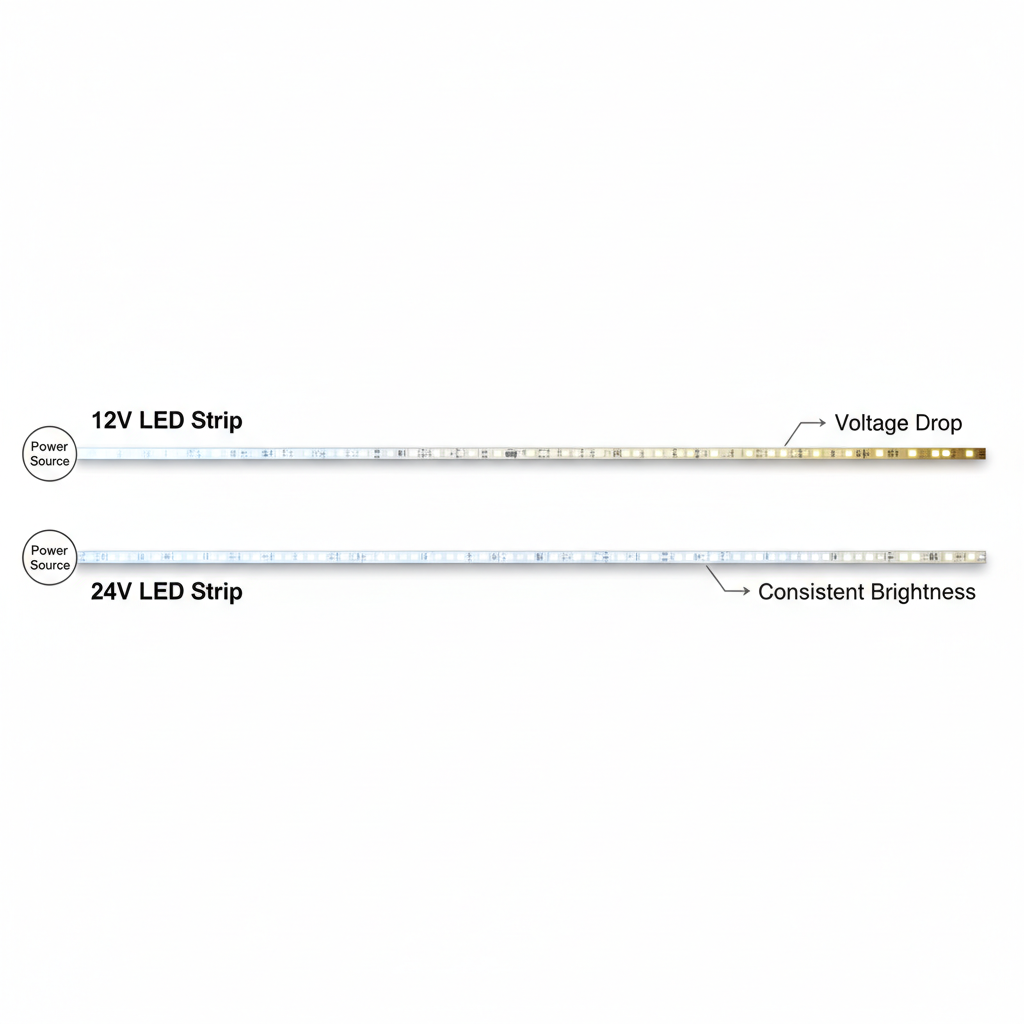
Have you ever seen an LED strip that is bright at the start but gets noticeably dimmer at the far end? That is voltage drop.
In simple terms, voltage drop is the loss of electrical pressure as it travels along a wire. All low-voltage lighting experiences this, but it is much more significant in 12V systems over longer distances.
The technical reason: For the same amount of power (Wattage), a 24V system draws half the current (Amps) as a 12V system. (Based on the formula Power = Voltage × Amperage). Lower current means less power loss to resistance, resulting in less voltage drop and more consistent brightness from start to finish.
2. Maximum Run Length
This is a direct result of voltage drop.
12V LED Strips: Due to the more significant voltage drop, a 12V strip can typically only run for 5 meters (16.4 feet) from a single power connection before the light starts to dim.
24V LED Strips: With their lower voltage drop, 24V strips can easily run for 10 meters (32.8 feet) or more from a single power connection.
This makes 24V systems much easier to install for large projects, as you need fewer power supplies and less complex wiring.
3. Amperage & Wire Size
Because 24V systems draw half the current (Amps) for the same power, they offer two key benefits:
- Thinner Wires: Lower amps require smaller, thinner (and often cheaper) wires.
- Smaller Power Supplies: A 100W, 24V power supply will be smaller and more manageable than a 100W, 12V power supply.
4. Cutting Increments (Precision)
This is the key advantage of 12V LED strip lights.
LED strips can only be cut at designated “cut lines.”
- On a 12V strip, these cut lines are typically closer together (e.g., every 3 LEDs, or about 2.5cm to 5cm).
- On a 24V strip, the cut lines are further apart (e.g., every 6 LEDs, or about 5cm to 10cm).
For projects that demand high precision and custom lengths—like fitting light into a tight jewelry display case, a museum exhibit, or a complex shelving unit—the shorter cutting increments of a 12V strip are a massive advantage.
The Case for 12V LED Strip Lights: Pros & Applications
Advantages of 12V:
- Precision Cutting: Shorter cut lines offer maximum flexibility for custom-fit installations.
- System Compatibility: Ideal for any application that already runs on a 12V DC system, making them the default choice for vehicles.
Best Applications for 12V:
- Vehicle & Marine Lighting: Cars, trucks, RVs, and boats all run on 12V batteries.
- Under-Cabinet & Shelf Lighting: When you have many short, precise lengths to fit.
- High-Detail Accent Lighting: Perfect for jewelry displays, museum cases, retail showcases, and model building.
- Small-scale DIY projects.
The Case for 24V LED Strip Lights: Pros & Applications
Advantages of 24V:
- Longer Run Lengths: The reason to choose 24V. Run up to 10m or more with consistent brightness from a single power source.
- Higher Efficiency: Less power is lost to voltage drop, making them slightly more efficient.Simpler Installation (for large projects): Lower amperage means less complex wiring and smaller components.
- Simpler Installation (for large projects): Lower amperage means less complex wiring and smaller components.
Best Applications for 24V:
- Large Commercial Spaces: Cars, trucks, RVs, and boats all run on 12V batteries.
- Architectural Lighting: When you have many short, precise lengths to fit.
- Long-Distance Outdoor or Landscape Lighting.
- Any project over 5 meters where consistent brightness is critical.
How to Choose: A Simple Checklist for Your Project
Still not sure? Ask yourself these four questions to find your answer.
1. Does my project require a single, continuous run longer than 5 meters (16.4 feet)?
YES: Choose 24V. It will make your installation vastly simpler and ensure even brightness.
2. Is cutting precision my top priority? (e.g., fitting into a tight, custom-built space)
YES: Choose 12V. The shorter cut lines will give you the flexibility you need.
3. For my project, what’s more important: “installation simplicity over a long distance” or “cutting precision for a short distance”?Installation Simplicity (Long Distance): Choose 24V.
Cutting Precision (Short Distance): Choose 12V.
Find the Perfect LED Strip Lights for Your Needs
Ultimately, there is no “best” voltage—only the right voltage for your specific application. Whether your project calls for the precision of 12V or the power of 24V, we have a high-quality, professional-grade solution for you.
Browse our full collection of 12V or 24V LED Strip Lights.
Still not sure? Contact our lighting experts. We have over a decade of experience designing custom lighting for high-end brands, museums, and commercial spaces. We’re happy to provide a free consultation to help you succeed.


